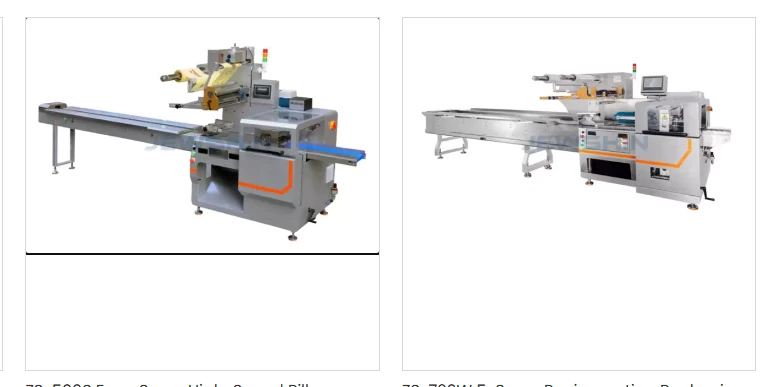
An automatic packaging machine prevents downtime by keeping product spacing, film feed, sealing, inspection, and discharge at a controlled rate instead of relying on manual timing. A line rated at 120 packs per minute can lose 7,200 packs during one hour of stoppage, while reducing daily downtime from 60 to 20 minutes raises basic operating availability on an 8-hour shift from 87.5% to 95.8%. Sensors can stop feeding before a jam grows, PLC alarms shorten fault finding, servo settings reduce repeated manual adjustments, and accumulation conveyors keep upstream equipment running during short downstream stops. The useful measure is good packages produced per scheduled hour, not maximum machine speed.
Packaging downtime becomes expensive because packaging normally sits near the end of a production process. When a wrapper, cartoner, sealer, or case packer stops, finished products continue arriving until available accumulation space is full. At 100 products per minute, a 15-minute stop represents 1,500 products that must either wait somewhere on the line or force upstream equipment to stop. A machine running for 420 minutes of an 8-hour, 480-minute scheduled shift has only 87.5% availability before speed losses and rejected packages are counted.
That availability figure explains why nameplate speed can give a poor picture of actual capacity. A machine rated at 150 packs per minute theoretically produces 72,000 packs in 480 minutes, but 85% availability reduces available running time to 408 minutes and theoretical output to 61,200 packs before slower cycles and rejects are included. At 95% availability, running time reaches 456 minutes and theoretical output reaches 68,400 packs. The 10-percentage-point availability difference represents 7,200 packages per shift at the same rated speed.
| 8-hour shift example | 85% availability | 95% availability |
|---|---|---|
| Available running time | 408 min | 456 min |
| Rated speed | 150 packs/min | 150 packs/min |
| Theoretical output while running | 61,200 | 68,400 |
| Difference | — | 7,200 packs |
Because lost minutes have a measurable production cost, automatic machines are designed to prevent small feeding errors from becoming long stops. Photoelectric sensors can confirm whether a product has entered a station, proximity sensors can check machine positions, encoders can measure movement, and pressure or temperature monitoring can identify operating conditions outside the programmed range. If a product fails to arrive at the expected position, the controller can stop the next feed cycle instead of allowing several products to enter the same space.
Product spacing becomes more important as speed rises. At 120 packs per minute, one packaging cycle lasts only 0.5 seconds; at 180 packs per minute, the available cycle falls to about 0.33 seconds. An operator cannot repeatedly correct misplaced products within such intervals. Automatic infeed belts, timing mechanisms, guides, and servo-controlled sections maintain separation before products reach the packaging area, reducing contact between products and reducing the number of manual corrections required during a shift.
A five-second interruption looks small on a production report. If it occurs 100 times during one shift, however, it removes more than 8 minutes of operating time. At 150 packs per minute, those repeated short stops represent more than 1,200 potential packaging cycles.
Short stops therefore deserve the same engineering attention as major breakdowns. Modern PLC and HMI systems can record alarm time, machine state, affected station, and fault frequency. Instead of a maintenance technician searching the entire line after every stop, the HMI can identify an open guard circuit, missing-product signal, film-end warning, servo fault, or downstream backup. If troubleshooting falls from 15 minutes to 5 minutes across four incidents, 40 minutes of scheduled production can be recovered in one shift.
Alarm records become more useful when they are grouped by duration and frequency rather than reviewed individually. Ten 30-second feeder interruptions consume five minutes, while one 20-minute sealing failure consumes four times as much time. A plant can therefore rank faults by total lost minutes and repair the equipment responsible for the largest accumulated loss. In a 2026 production environment with networked controls, machine counters and timestamps can also be transferred to supervisory or manufacturing systems instead of relying on handwritten stop records.
Once recurring stops are measured, packaging-material supply becomes another controllable source of lost time. Film rolls, labels, cartons, trays, adhesive, and other consumables have finite capacity. If a film roll supports 40 minutes of production and changing it requires four minutes, twelve changes across an 8-hour operating period can consume 48 minutes if every replacement requires a complete stop. Low-material sensors and remaining-roll warnings allow operators to prepare the next roll before the current supply is exhausted.
Some packaging configurations reduce the interruption further through film splicing or dual-roll arrangements. Even without automatic splicing, advance warning matters: cutting a four-minute replacement to two minutes across twelve daily changes recovers 24 minutes. At 100 packages per minute, those 24 minutes equal 2,400 potential cycles. Consumable replacement should therefore be treated as scheduled machine time, not an unpredictable interruption.
Material supply leads naturally to film handling, where stable tension and registration have a large effect on wrapper availability. A horizontal flow wrappe typically coordinates an infeed conveyor, film unwind, forming section, longitudinal sealing, cross-sealing jaws, and discharge. At 120 packages per minute, the machine completes 7,200 cycles per hour, so small errors in film tracking, product pitch, or jaw timing can repeat thousands of times before the end of a shift if detection is poor.
Servo-controlled motion helps because product position, film length, and sealing motion can be coordinated through stored parameters instead of repeated mechanical adjustment. If a 200 mm package changes to a 250 mm format, an automated recipe can recall compatible length, speed, registration, and timing settings where the machine design supports electronic adjustment. Manual components may still require repositioning, but reducing repeated adjustments lowers setup time and reduces the chance of restarting with an incorrect setting.
Changeovers deserve separate measurement because planned downtime can consume a large share of available hours in facilities producing many SKUs. Consider four daily format changes taking 30 minutes each: two hours of an 8-hour shift, or 25% of scheduled time, are unavailable before breakdowns are counted. Reducing each changeover to 15 minutes returns one production hour per day. Over 250 operating days, the recovered capacity reaches 250 hours, equal to more than thirty-one 8-hour shifts.
| Changeover case | 30 min/change | 15 min/change |
|---|---|---|
| Changes per day | 4 | 4 |
| Daily stopped time | 120 min | 60 min |
| Share of an 8-hour shift | 25% | 12.5% |
| Annual time at 250 days | 500 hr | 250 hr |
Stored recipes are only part of that reduction. Tool-less guides, numbered position indicators, quick-release forming parts, accessible sealing assemblies, and clearly identified format components reduce mechanical setup. Verification still matters because an incorrect guide width or sealing temperature can produce rejects immediately after restart. A five-minute first-piece verification is preferable to producing 500 questionable packages at 100 packs per minute and then sorting or repacking them.
Quality control therefore belongs in the downtime discussion. A machine can run continuously and still lose useful capacity when packages fail weight, seal, label, code, or contamination checks. Suppose a line makes 50,000 packages and rejects 2%; 1,000 packages are not saleable. Reducing rejects to 0.5% lowers the rejected quantity to 250, returning 750 good packages without increasing rated machine speed. The production gain comes from using existing cycles more effectively.
Automated checkweighers, barcode readers, vision inspection, metal detection, and reject stations can inspect products without stopping every cycle. Their benefit depends on correct setup and validation; a poorly configured sensor can generate false rejects just as easily as a packaging fault can generate bad packs. Inspection data should therefore be compared with actual defect findings, especially after product or package changes, so a rising reject percentage can be separated from an inspection-setting problem.
Inspection also prevents defective output from occupying downstream equipment. If 2% of 10,000 packages have unreadable codes and are detected only after case packing, as many as 200 units may need to be located and removed from completed cases. Detecting the same problem immediately after coding allows individual packages to be rejected before they consume cartoning, case-packing, conveying, or palletizing time. That keeps downstream capacity available for acceptable products.
Downstream capacity matters because the fastest packaging machine cannot overcome a slower next station. A wrapper producing 140 packs per minute feeding a cartoner limited to 110 creates a theoretical difference of 30 packs every minute. Without accumulation or speed coordination, 300 packs can build up in only 10 minutes. Line design therefore needs capacity figures for every major station rather than one machine viewed separately.
Accumulation conveyors provide time for short disturbances to clear without immediately stopping upstream production. A buffer holding 300 products gives three minutes of protection at 100 products per minute if downstream equipment stops while upstream production continues. A 600-product buffer provides six minutes under the same conditions. Buffer size should reflect actual stop duration, product stability, available floor space, and whether products can safely contact one another.
Accumulation does not remove downtime. It prevents a short stop at one station from becoming the same-length stop at every connected station.
Communication between machines adds another layer of control. A downstream-full signal can ask upstream equipment to slow or stop feeding before products collide, while a downstream-ready signal permits controlled restart. Variable-frequency drives and servo systems can adjust conveyor speeds instead of relying only on abrupt start-stop operation. When a line contains five or more connected machines, coordinated status signals can prevent one local interruption from producing several separate jams during restart.
Maintenance determines whether those controls remain useful after thousands of operating hours. Bearings, belts, chains, heaters, sealing jaws, cutting components, sensors, vacuum systems, pneumatic cylinders, and electrical connections all have service requirements. Waiting for complete failure moves maintenance into production time. Scheduling inspection by operating hours or cycle counts places more work into planned maintenance periods, where technicians can prepare parts and tools before the machine is stopped.
Cycle-based servicing can be more informative than calendar servicing for heavily used equipment. A component on a machine completing 120 cycles per minute accumulates 57,600 cycles during an 8-hour shift at continuous operation. Over 250 shifts, that is 14.4 million theoretical cycles. A second machine running only two shifts per week may reach the same calendar age with a much lower mechanical duty, so equal annual maintenance schedules do not necessarily reflect equal wear.
Spare-parts planning also changes downtime duration. If a failed sensor takes 15 minutes to replace but the replacement is unavailable for 24 hours, repair skill is not the limiting issue. Plants can review failure history, lead times, component commonality, and machine criticality when deciding which parts to hold locally. Components with short replacement times but long supplier lead times deserve attention because inventory availability can determine whether a stop lasts minutes or a full production day.
Operator training affects the same maintenance figures. A technician should not be required for every minor product misfeed, while operators should not bypass guards or make adjustments outside their training. Standard restart procedures can specify what an operator may clear, what requires maintenance, and what conditions require the machine to remain stopped. If 20 minor stops per shift each take one minute longer because responsibilities are unclear, more than 33 minutes are lost.
OEE provides a useful framework for combining several losses. Availability measures whether the machine was running when scheduled, performance compares actual running speed with its expected speed, and quality measures the proportion of acceptable output. A line with 90% availability, 95% performance, and 98% quality has an OEE of about 83.8%, because the three percentages are multiplied rather than averaged. Improving availability alone will not produce full benefit if performance or quality remains low.
For example, increasing availability from 90% to 95% while keeping performance at 95% and quality at 98% raises OEE from about 83.8% to 88.4%. On a machine theoretically capable of 72,000 packages per shift, that 4.6-percentage-point difference corresponds to roughly 3,300 additional effective packages under the simplified OEE calculation. Tracking availability, performance, and quality separately shows whether future engineering work belongs in maintenance, speed control, material handling, or package quality.
The purchasing specification should therefore include more than maximum packs per minute. Engineers can compare sustained speed using the intended product, changeover minutes, required operators, reject handling, cleaning access, alarm history capability, spare-parts lead time, accumulation requirements, and integration with upstream and downstream controls. A machine rated at 180 packs per minute but operating at 75% availability provides less theoretical running output than a 160-pack-per-minute machine operating at 90% availability: 64,800 versus 69,120 packs during an 8-hour shift before other losses.
A realistic acceptance test can make those differences visible before regular production begins. Rather than proving only that a machine reaches maximum speed for several minutes, a manufacturer can run representative products for four or eight hours, record stops, count rejects, perform at least one format change, and calculate sustained good output. A four-hour test at 120 packs per minute contains up to 28,800 cycles, providing far more operating information than a short demonstration based on a few hundred packages.
Production teams can then compare the acceptance data with actual shift results after installation. If an eight-hour target is 60,000 good packages but production repeatedly reaches only 52,000, the 13.3% gap can be separated into stopped time, reduced speed, rejects, material waiting, and changeover losses. Each category points to a different engineering response, allowing automatic packaging equipment to be managed around measurable production hours rather than its brochure speed.