Collecting goods from several suppliers can involve different readiness dates, package sizes, documents, loading conditions, and delivery terms. Buyers can reduce missed pickups and avoidable storage by tracking each lot separately, defining a common booking plan, confirming supplier readiness with evidence, and assigning one owner to each handoff. Consolidation may help coordinate a shipment, but it should be compared with the timing, handling, and cost of separate dispatches.
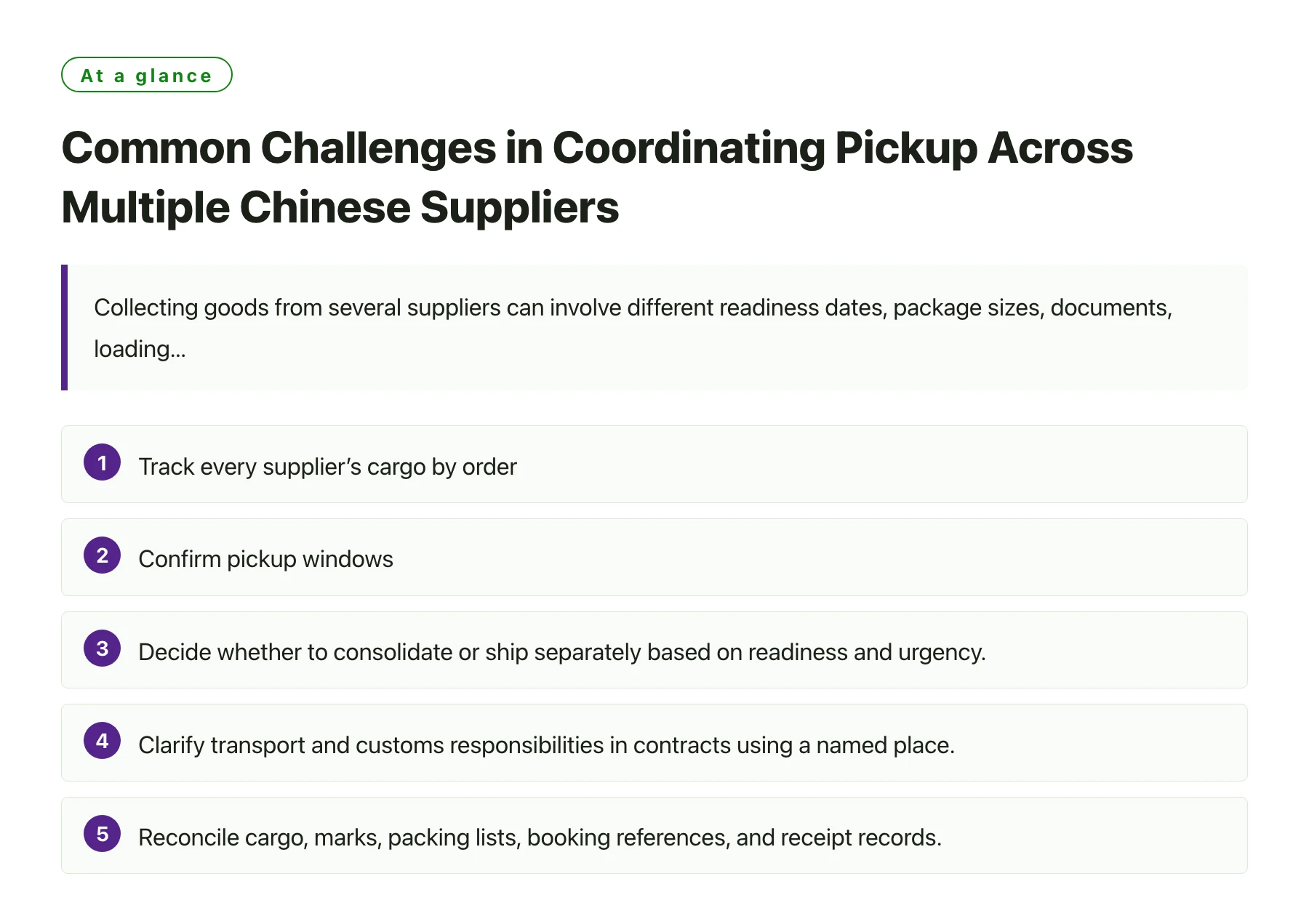
Key takeawaysTrack every supplier’s cargo by order, lot, readiness date, location, and package data. · Confirm pickup windows, loading equipment, documents, and access before dispatch. · Decide whether to consolidate or ship separately based on readiness and urgency. · Clarify transport and customs responsibilities in contracts using a named place. · Reconcile cargo, marks, packing lists, booking references, and receipt records.
A pickup calendar should show both shared bookings and supplier-specific exceptions.
Create one cargo register across suppliers
For each order, record supplier, factory or warehouse address, buyer reference, product, lot, carton or bundle count, dimensions, gross weight, pallet pattern, handling constraints, ready date, and destination. Keep each supplier’s data distinct even when orders may be consolidated. Use a common unit system and identify estimates that still need confirmation.
Add document status: invoice, packing list, origin information, export instructions, product records, and any other files required for the route. Name the party preparing and checking each item and the deadline before pickup. A carrier booking should not be treated as proof that a supplier’s cargo or documents are ready.
Buyers using JS Sourcing shipping from China can coordinate a shared register among suppliers, warehouse, forwarder, and receiving team. Identify who owns updates and how changes to dimensions, quantity, or ready dates will be reported.
Confirm what “ready” means for each supplier
Define readiness conditions for the order: production completion, quality release, final packing, palletization, labels, export documents, and access for loading. A supplier may be “finished” in production but still lack cartons or a release approval. Ask for the evidence needed to move the cargo into the pickup plan, such as a current pack list, final measurements, photos, or written lot confirmation.
Set a cutoff for readiness confirmation before the planned vehicle arrives. Require the supplier to notify the pickup coordinator if quantities, package sizes, or location change. Decide how to handle partial readiness: pick up completed goods, defer the full lot, or rebook. The choice affects cost and schedule, so assign a person authorized to decide.
Check the physical pickup location and operating hours. Confirm vehicle access, loading dock or forklift availability, packaging protection, safety rules, and contact details for the day of collection. If a supplier uses a third-party warehouse, verify that the release instruction and cargo identifiers are understood by both parties.
Coordinate pickup sequence and time windows
List collection stops, distance and transit assumptions, supplier operating hours, cargo dimensions, loading time, and port or consolidation cutoff. Ask the forwarder to evaluate vehicle capacity and stop order using current shipment data. A route that looks efficient on a map may not work if one supplier’s loading window is narrow or its goods need different equipment.
Build buffers for traffic, waiting, document checks, supplier delays, and loading. Tell each supplier the expected vehicle and arrival window and provide a contact for exceptions. Avoid giving several factories the same unqualified pickup time if one delay could cause later stops or a missed booking.
Decide who may approve a route change or additional pickup fee. If a vehicle cannot load all cargo, define the priority order and where remaining goods will be held. Record any partial pickup by product and lot so the warehouse and buyer do not assume the full order moved.
Choose consolidation or separate dispatch
Compare consolidation when suppliers’ goods can meet the same booking, handling, customs, and delivery requirements. Consider readiness date, warehouse dwell time, cargo compatibility, package dimensions, urgency, damage exposure, and the cost of waiting for the slowest lot. Goods with special storage or handling needs may not belong in the same shipment.
Ask the forwarder to price and explain the actual consolidation plan, including origin collection, warehouse receipt, sorting, repacking if any, documentation, storage, loading, and destination charges. Confirm which party pays for each step and what happens if one supplier misses the cutoff. A consolidation quote should use actual package counts and dimensions.
A single consolidated booking can simplify some administration but may create a delay or shared disruption. Separate shipments can move ready goods earlier but may involve repeated pickups and fixed charges. Choose based on the project’s required arrival, stock urgency, total cost, and operational risk rather than assuming either option is always better.
Clarify transport, cost, and risk responsibilities
Review the delivery term and exact named place in every relevant purchase contract. The U.S. International Trade Administration explains that Incoterms allocate defined tasks, costs, and risks between seller and buyer, including transport, insurance, documentation, and customs responsibilities. [1] Ensure the chosen rule fits the intended route and that parties understand where delivery and risk transfer occur.
Identify activities not covered by the term or service agreement: collection from additional factories, warehouse handling, export declarations, freight, insurance, customs brokerage, duties, demurrage, destination unloading, and final-mile delivery. Ask for written estimates and show which are fixed, variable, or subject to confirmation. Avoid duplicate charges when a supplier or forwarder already includes a leg.
Name who can instruct pickup, approve additional charges, select a carrier, declare cargo details, and respond to a customs or security query. Keep the buyer, supplier, broker, forwarder, and receiving contact on one escalation list. If a party lacks authority to make a decision, state who must approve it and how quickly.
Align cargo documents and physical marks
Ensure each shipment’s invoice and packing list match the product, quantity, supplier, shipper, consignee, package count, and purchase-order references. Confirm how a consolidated booking will relate to separate supplier invoices and lots. Work with a qualified customs broker on classifications, origin, valuation, and required declarations for the destination.
Use marks that identify supplier, order, product, carton number, handling orientation, lot, and destination where appropriate. Keep labels consistent with the cargo register. Do not put all goods under a generic description that makes receiving, customs review, or damage claims difficult. If the forwarder applies new labels or palletizes cargo, record the change and retain the original references.
Require suppliers to send final package measurements and counts before the booking cutoff. Reconcile changes against the transport instruction and container or vehicle plan. Incorrect weight or dimensions can affect equipment allocation, freight pricing, and loading feasibility. Keep a timestamped version of the data used to book.
Manage storage, handling, and exceptions
Confirm how cargo will be protected if it arrives early or waits for consolidation. Ask about warehouse conditions, stacking, segregation, security, handling equipment, and chargeable dwell time. Identify products that must remain upright, dry, temperature-controlled, or separate from other goods. The product owner should define handling limits; a generic warehouse assumption may not protect sensitive cargo.
Set exception steps for a missed pickup, damaged package, short quantity, missing document, rejected release, or customs hold. Define who notifies whom, where cargo will be held, how costs are approved, and what evidence is preserved. A photo should include package identifiers or location so it can be linked to the right supplier and lot.
When goods are damaged or mixed, do not simply continue the route without recording condition and quantity. Ask the buyer or quality owner whether cargo should be quarantined, repacked, re-inspected, or shipped under a documented exception. Keep the supplier and carrier informed using the agreed escalation path.
Track departure through receiving
After loading, record vehicle or container reference, seal where applicable, pickup time, quantities collected, and the party taking custody. Confirm that booking and transport documents are issued and circulated. Track milestones through export handoff, departure, arrival, customs release, warehouse receipt, and final delivery. Assign someone to check each milestone rather than relying on notifications alone.
At destination, compare delivered packages with the register, packing list, marks, and release file. Record visible damage, shortages, mixed lots, or late delivery with photographs and delivery notes. Notify the responsible parties within contractual deadlines and retain packaging or damaged items if a claim may require inspection.
After the shipment closes, compare planned and actual pickup times, storage, freight, extra fees, document quality, and delivery. Identify which issue came from supplier readiness, route planning, warehouse handling, or buyer change. Adjust the next pickup calendar and responsibility map based on evidence.
Use a repeatable pickup-control checklist
Before booking, verify that every supplier has a confirmed lot, approved release, final package data, available pickup window, loading equipment, and document owner. Confirm route, vehicle, consolidation plan, charges, destination, and exceptions. Send concise instructions to each supplier and retain acknowledgments.
On pickup day, confirm vehicle identity and contact, count packages, photograph condition where needed, record discrepancies, and obtain a handoff record. Update the cargo register as each stop completes. Notify the forwarder promptly if the next stop or cutoff is at risk.
At closeout, reconcile packages, costs, transport references, documents, and receipt. Save the final route and supplier-specific records with the purchase orders. Use the checklist as a control, not a replacement for the contract, broker guidance, or product-specific handling instructions.
Sources
Frequently asked questions
Should all supplier cargo be consolidated into one shipment?
Not always. Compare readiness, urgency, handling compatibility, storage, route costs, booking deadlines, and the effect of waiting for the latest supplier.
What should a supplier confirm before pickup?
Confirm lot release, quantity, final package dimensions and weight, labels, documents, loading access, pickup window, and the contact responsible on site.
Who pays for extra pickups or warehouse storage?
The contract and service agreement should allocate those costs. Obtain approval rules and written estimates before changing the planned route.
What records should be kept after pickup?
Keep order, supplier, product, and lot references; collected quantities; package condition; pickup time; custody handoff; booking numbers; transport documents; and receipt records.