How Creators Get Noticed on an NSFW AI Platform
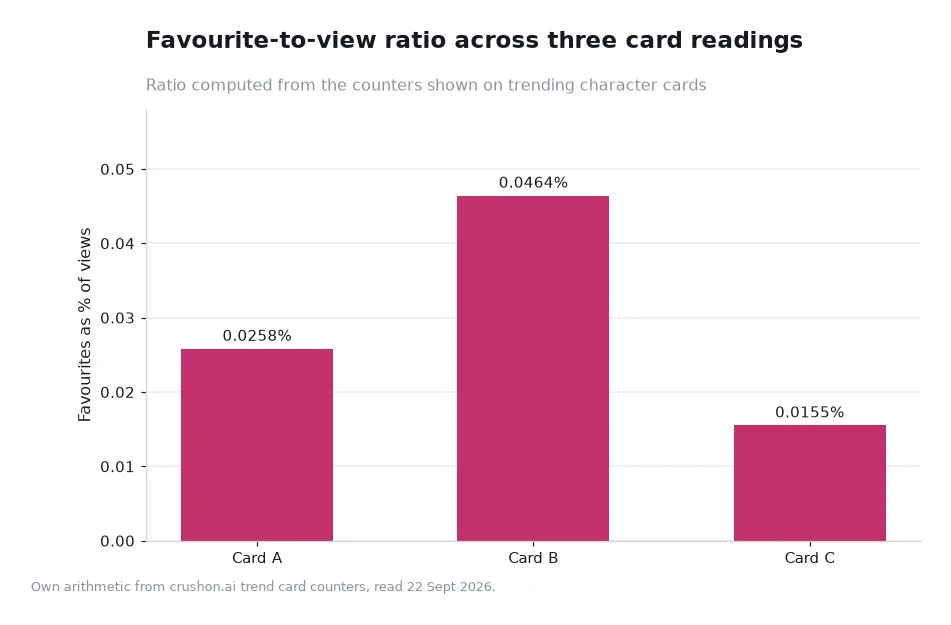
Visibility on a character platform is not a mystery; it is a small set of levers, and every one of them is visible to anyone who reads a card carefully. The strongest signal is the favourite-to-view ratio, which ranges from about 0.0155% to 0.0464% across cards sitting near each other in the same chart. That spread is roughly threefold, and it exists inside a single week's ranking, which tells you the levers are real.

Key takeaways
- Four levers decide whether a card gets found: its label set, the written setup, the creator credit, and how often its favourites accumulate.
- The weekly chart holds twenty entries and is rebuilt every Thursday, so timing a release near the reset is worth more than volume alone.
- Ratios of 0.0155% to 0.0464% show that saving behaviour varies far more than raw reach does.
- A card needs a written situation, not a name: the setup is the only part of a listing a reader can evaluate before opening it.
Lever one: the label set
Labels decide which searches a card can appear in. A broad set such as Unfiltered, Fictional and Female places a creation into enormous pools where competition for the top of a grid is fierce; a precise set places it in smaller pools where it can rank near the top almost immediately. The trade is reach against position, and most new creations do better by winning a small pool first.
Labels also have to match the writing. A card labelled Submissive that opens with a passive first line teaches readers to distrust the label, and the ratio absorbs the damage long before any comment does.
Lever two: the written setup
The setup is the product. On a platform whose entries are text, the description of who the character is, what situation they are in and how they speak is what makes the first three messages go somewhere. Crushon credits a creator on each card, so the setup is also the only asset that follows a name across several entries.
Practical guidance follows directly. Write two or three sentences of situation rather than a list of adjectives, and give the character one specific thing to want. A reader evaluating twenty listings in ten minutes is comparing setups, not labels, because the setup is the only thing that distinguishes one card from another at a glance.
Lever three: the creator credit
Creator pages are a distribution channel in their own right. The platform keeps Creators and Characters as two separate lists, and a reader who enjoyed one card will look for its author before searching again. That means a small, coherent catalogue from one creator compounds: three cards in the same register sell each other, while five cards in five unrelated registers simply fragment the audience.
Lever four: the counter rhythm
Favourites accumulate over time, so a card's ratio is partly a function of how long it has been listed and how often it is surfaced. Because the weekly chart is rebuilt every Thursday, an entry that moves near the top keeps receiving impressions, and those impressions keep adding favourites. Nothing about that is hidden; it is the ordinary compounding of a ranked list.
| Lever | Decision to make | Observable result | Common mistake |
|---|---|---|---|
| Labels | Broad pool or precise pool | Where the card appears in search | Tags that overpromise the writing |
| Setup | Situation and one specific want | How long a first session runs | A name and a list of adjectives |
| Creator credit | One register or many | Whether readers return by author | Unrelated cards under one name |
| Rhythm | When the card is published | Whether it lands in a fresh chart | Publishing just after a reset |
Worked example: what one save is worth
Turn a ratio into counts. At 0.0175%, roughly one visiter in 5,700 saves a card: 1 ÷ 0.000175 ≈ 5,714 views per favourite. At 0.0292%, the requirement falls to 1 ÷ 0.000292 ≈ 3,425 views per favourite, and at 0.0526% it falls to about 1,901 views. In other words, moving a card from the lowest reading in the set to the highest cuts the number of views needed per save by roughly two thirds.
Now apply that to a modest target. Fifty favourites at 0.0175% needs about 285,700 views; at 0.0292% it needs roughly 171,250. The two figures differ by about 114,000 views, which is the arithmetic reason a better label choice and a tighter setup are worth more than extra volume. Both counts are derived from the same card readings and are presented here as arithmetic rather than as a forecast.
A second illustrative figure: if a creator publishes one card a fortnight, that is 26 cards a year, or roughly two new entries per weekly chart cycle every four weeks. The cadence is an assumption about a habit, not platform data, but it shows why consistency beats bursts — each new card adds a fresh chance to enter a pool while older cards keep collecting favourites.
Reading the chart like a creator
Twenty positions, a Thursday reset and a pair of counters per card are enough to plan a release. Look at which label combinations appear more than once in the chart, since repetition is evidence that a pool is deep, then check the ratios of the newest entries, because a high ratio on a young card suggests the fit is strong rather than the reach.
Three tools make the review quick. The nsfw ai chat chart shows which label combinations repeat from one week to the next, and behind it sit two more tools. The character search shows how crowded a chosen label really is before a card is published into it, and the weekly rankings show whether an entry held its place through the reset. On a catalogue of NSFW AI characters, the creators who get noticed are usually the ones who chose a narrow pool, wrote a real situation, and then kept publishing in the same register.
Frequently asked questions
Do views or favourites matter more for visibility?
Favourites. Views measure exposure, while saves measure the decision to come back, and a card with 0.0464% will outrank a card with 0.0155% on every comparison that matters.
Is it better to use many labels or few?
Use as few as accurately describe the card. Extra labels add pools but weaken the match, and a weak match shows up as a low ratio rather than as a complaint.
How often should a creator publish?
A steady cadence beats occasional bursts, because every new entry is a fresh chance to enter a pool while older cards continue to accumulate saves.
Does the creator name really change anything?
It does. Readers who like one card look for its author next, and the platform lists Creators separately from Characters to make that path straightforward.
Four levers, one habit
Treat labels, setup, credit and rhythm as a checklist rather than as separate projects, and review it after each Thursday reset. Choose a pool you can win, write a situation rather than a description, keep your entries in one register, and publish on a cadence you can hold for a year. None of that is a trick; it is simply the set of decisions the chart measures.
Data and sources: trend card counters and the weekly chart on the Crushon trends page[1], read 22 Sept 2026; view-per-favourite figures are own arithmetic on those counters and the publishing cadence is an illustrated assumption. Written for an adult audience, 18 and over.